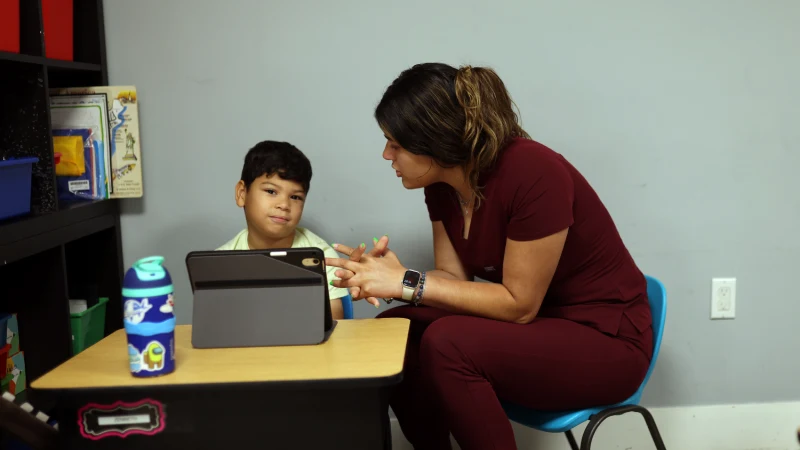
Surely, from the initial diagnosis to the first therapy sessions, your life as a parent of a child with autism has revolved around improving their learning.
However, as school age approaches, an inevitable question arises more strongly: What happens with autism after early intervention?
It is common to feel like the roadmap you were following has reached its end, but in reality, you are simply “shifting territories.”
That is why at Koala ABA, we designed this guide to help you understand that, at this stage, support evolves toward autonomy, social integration, and academic success.
Do you want to know what steps to take as your child enters this new stage? Read on!
Is Early Intervention Just the Beginning of Autism Treatment?

It is common for many programs to formally end when a child with autism enters elementary school, leading families to think that treatment has concluded.
However, the reality is that autism after early intervention requires a “marathon” mindset rather than a “sprint.”
Without a doubt, this initial phase is the foundation of your child’s development, but their independence continues to be built throughout their entire childhood and adolescence.
To understand this stage, consider these fundamental pillars:
- Constant Neuroplasticity: Although the early years are key, the brain maintains its ability to learn throughout life.
- Dynamic Development: As social and school demands increase, new areas arise that require specialized support.
- Evolution of Goals: Basic goals (such as eye contact) evolve into more complex, social, and functional skills.
- Absolute Individuality: Therapy is not static; it must always be adjusted to each child’s unique emotional and biological rhythm.
How Does Autism After Early Intervention Change for Your Child?
When looking at autism after early intervention, progress becomes less linear, focusing instead on how the child interacts with a world that is becoming increasingly larger for them.
In this new phase, we stop focusing on “what the child knows” and start focusing on “what they can do with what they know.” Therefore, their progress usually manifests through three key elements:
- Functional Communication: Evolving from simple labeling to expressing desires, emotions, and experiences.
- Emotional Self-Regulation: Developing tools to manage frustration and effectively reduce challenging behaviors.
- Autonomy and Social Skills: Achieving independence in daily routines and active interaction with other children their age.
What Should You Do When Your Child’s Progress Seems to Stall?
At this point, it is natural to feel that your child has reached a “plateau” where they don’t seem to be moving forward.
However, these periods are usually consolidation phases, where the brain processes what has been learned before taking the next leap.
In these “stagnation” states, keep in mind:
- The Need to Adjust Goals: Sometimes a plateau indicates that the child needs more motivating or natural challenges.
- Review of Intensity: A change in autism therapy may be necessary to avoid boredom and a lack of motivation.
- External Factors: School changes, moving, or changes in sleep patterns can temporarily affect the pace of learning.
How to Adjust ABA Therapy Goals as Your Child Grows.

The reality is that the key to therapy remaining effective for your child is evolution.
Evidently, a therapy that “does not change with the child” becomes obsolete. That is why, when addressing autism after early intervention, we specialists must prioritize the development of autonomy.
Our goal is for your child to require less and less supervision. To achieve this, goals focus on:
- Community Safety: Recognizing danger signs, crossing the street, and knowing what to do if separated from parents.
- Pre-vocational Skills: Following multi-step instructions and organizing their own school materials.
- Advanced Self-Care: Basic meal management and preparation for puberty and its changes.
- Conflict Resolution: Learning to negotiate and compromise in everyday social situations.
Why is Skill Generalization Important in Autism?
Yes, a child can often perform a task perfectly at the clinic… but fails when trying it at home.
However, the success of autism treatment after early intervention depends on a vital factor: generalization. Here are some keys on how to implement it in different environments:
- At Home: Ensuring communication skills are used with the participation of parents, siblings, and other family members.
- At School: They must be able to follow classroom rules without the need for constant reinforcement.
- In the Community: They should achieve functional behavior at the supermarket, the park, or the doctor’s office.
How to Effectively Prepare Your Child for the School Environment.
Undoubtedly, moving from a controlled therapeutic environment to a school classroom full of new stimuli is a great challenge for a child with autism.
Therefore, school readiness is clearly the bridge that ensures the child not only attends school but actually learns and actively participates in it.
To ensure this change is not traumatic in autism after early intervention, we work specifically on:
- Group Listening Skills: Attending to a teacher who is speaking to several children at once.
- Transitions Between Activities: Moving from play activities to another task without showing anxiety.
- Requesting Help: Knowing how to raise their hand, take turns, or approach the teacher when something is difficult.
What Long-Term Support Options Exist for Children with Autism?
Finally, autism after early intervention benefits enormously from a multidisciplinary approach. Of course, there is no single solution, but rather a combination that can adapt to your child’s life.
The most effective evidence-based therapies are:
- ABA Therapy: Focused on behavior modification, autonomy, and adaptive skills.
- Speech Therapy: Crucial for developing the functional social use of language.
- Occupational Therapy: For children still facing sensory or motor challenges that affect their independence.
Frequently Asked Questions About Autism After Early Intervention.
1. Does autism “end” after early intervention?
No. Early intervention is only the first step of the therapeutic process.
Autism after early intervention requires continuous support that evolves toward autonomy, social integration, and long-term academic success.
2. What are the changes in autism after early intervention?
After this stage, progress tends to focus less on basic skills and more on functional communication, emotional self-regulation, social skills, and daily autonomy, especially in school and community settings.
3. Should ABA therapy change as my child grows?
Definitely. Effective therapy must evolve with the child.
After early intervention, goals are adapted to foster independence, community safety, self-care, and social conflict resolution.
Koala ABA & Learning Centers: Support Beyond Early Intervention.

Autism after early intervention is the start of a phase where progress transforms into independence, social participation, and long-term family well-being.
At Koala ABA & Learning Centers, we understand that the needs of children with autism change with age, the school environment, and new social challenges.
That is why our autism services in Florida are designed to accompany families far beyond the early years, with dynamic therapy plans that grow alongside your child.
Our approach is based on a holistic view of development, where progress is built with strategy and family collaboration.
What makes Koala ABA different? We offer you:
- Real-time Evaluation and Data Analysis: We measure every advancement to adjust therapeutic goals precisely and effectively.
- Parent Training: We empower you so that learned skills are maintained and generalized at home and in the community.
- Presence in Florida: We have multiple centers to provide you with constant, accessible, and local support.
- Family-Centered Model: We know that your child’s progress directly impacts the quality of life of the entire household.
In this way, at Koala ABA, we work to ensure that autism after early intervention is a stage of growth, autonomy, and new opportunities for your child.
If you feel it’s time to redefine goals and move forward with a clear plan, we are ready to help!
Contact us today, and let’s take the next big step in your child’s development together.