When you are the parent of a child with autism, you face hundreds of complicated decisions daily. But choosing the right therapeutic path is, without a doubt, the most important one. In this regard, ABA Therapy is always the right direction, but that’s where crucial questions arise for you:
Where should my child receive therapy? Should I commit to In-School ABA Therapy… or In-Home?
At Koala ABA & Learning Centers, we know that choosing the learning environment is as vital as the therapy itself. That is why we have created this guide to help you discover which one, In-School ABA Therapy or In-Home, offers the best benefits for your child’s progress.
Ready to decide on the best option for your child? Let’s start clearing up your doubts!
How Does the Environment Affect the Effectiveness of ABA Therapy?

Applied Behavior Analysis (ABA), or ABA Therapy, is not an approach designed only to reduce challenging behaviors, but also to improve communication and social skills in children with autism through positive reinforcement.
However, for this science to function to its maximum potential, choosing the learning environment is fundamental.
Therefore, the place where your child receives behavioral therapy, whether it is In-School ABA Therapy or In-Home ABA Therapy, determines the types of skills they will develop, the frequency of sessions, and the speed with which they will be able to apply what they have learned outside of those sessions.
Let’s analyze how the environment directly influences the success of the ABA program for each child with autism.
In-Home ABA Therapy: Why Choose the Familiar Environment?

In-Home ABA Therapy is the most common intervention setting and, perhaps, the most intuitive. Now imagine your child feeling secure in their familiar space: this comfort factor allows them to quickly focus on their tasks, minimizing the stress associated with new places.
Furthermore, when compared to In-School ABA Therapy, this environment is excellent because it makes it easier for the individualized ABA treatment plan to adapt to real-life daily routines, integrating each intervention naturally.
What Are the Key Advantages of At-Home ABA Therapy?
The advantages of at-home ABA therapy are closely related to the intensity of the sessions and family involvement, which accelerates skill development in children with autism. To give you a clearer perspective, here are the most significant benefits of at-home ABA therapy:
- Low-Stress Environment: The familiar setting facilitates connection with the child and minimizes challenging behaviors.
- High Family Involvement: Guarantees parent training in real-time, maximizing the treatment’s impact.
- Focus on Essential Routines: The work centers on everyday skills such as mealtime, hygiene, and functional play.
- Individual Sessions: Optimizes skill acquisition and the generalization of behavior more quickly.
When Is It Best to Start ABA Therapy at Home?
Choosing at-home therapy over In-School ABA Therapy should not be a permanent decision, but a strategic one. At this point, there are very specific times and profiles where this environment provides a more solid foundation for learning.
So, if your goal is the acquisition and development of routines in a controlled environment, this option could be perfect:
- For Younger Children: It is ideal if they are learning fundamental skills like basic communication or imitation.
- For Collaborative Families: If you prefer close collaboration with ABA therapists to apply daily strategies.
- For Routine Transitions: It is the indicated option if the child needs specific help with daily routines like dressing or using the bathroom.
In-School ABA Therapy: How Does It Drive Socialization in Autism?

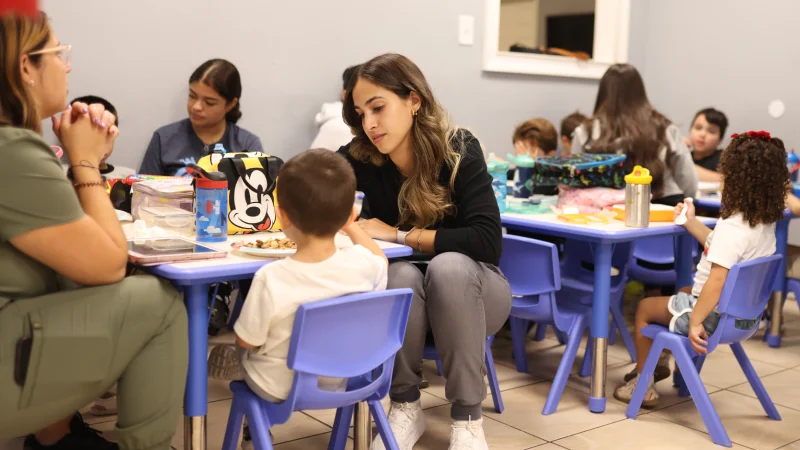
In-School ABA Therapy is key when your child’s goals focus on social life, academic success, and the development of their potential. In this way, this model integrates the therapist directly into the educational learning environment, in collaboration with school staff.
Furthermore, this integration allows behavioral intervention strategies to be applied in real-time, precisely where difficulties arise: during interaction with peers, classroom transitions, or concentration on assigned tasks.
Undoubtedly, In-School ABA Therapy is the best way to practice collaboration with teachers and academic support.
What Social Skills Are Learned in School-Based ABA?
One of the greatest challenges for children with autism is social interaction with their peers in different settings. In this sense, In-School ABA Therapy is unparalleled, as it provides natural training for the development of fundamental social skills.
At Koala ABA, our approach ensures the therapist reinforces behavior during spontaneous interactions through:
- Real-Time Behavioral Training: Positive reinforcement is applied exactly when challenging behaviors or interaction opportunities occur in the classroom.
- Social Skill Development: Skills such as reciprocal play, turn-taking, conflict management, and functional communication are practiced with other children.
- Academic Support: Strategies are offered for task completion and adaptation to changes in class or activity.
- Professional Collaboration: Ensures strategy consistency thanks to fluid communication between BCBAs, teachers, and aides.
For Whom Is In-School ABA Therapy Most Suitable?
While all children benefit from these interventions, there are certain characteristics and ages where In-School ABA Therapy generates more effective results. Next, we show you the profiles that typically find greater success in these therapy environments:
- School-Aged Children: Those whose primary challenge is peer dynamics or the classroom environment.
- Students Who Benefit from Predictability: The school environment, with its predictable routine, fosters structured learning.
- Families Seeking a Bridge: For those looking for consistency between school expectations and home life.
Frequently Asked Questions about In-School or In-Home ABA Therapy.
1. What is ABA Therapy and how does it help children with autism?
ABA Therapy uses positive reinforcement to improve communication, social skills, and the behavior of children with autism. It adapts to their needs and favors the application of what is learned in daily life.
2. What is the difference between In-School and In-Home ABA Therapy?
- In-Home: Ideal for daily routines, basic skills, and learning in a familiar environment. It involves the family and allows for individualized sessions.
- In-School: Encourages socialization, interaction with peers, and academic learning. It applies ABA strategies in real classroom situations.
3. For which children is In-School ABA Therapy most suitable?
It works best for school-aged children with social challenges, those who benefit from the classroom structure, and for families seeking consistency between school and home.
How Do We Guarantee Unique Treatment Plans at Koala ABA?

At Koala ABA & Learning Centers, we understand that there is no single approach that works for all children with autism. That is why our Koalafied® approach focuses on designing completely personalized ABA Therapy plans based on a deep understanding of each child’s needs.
Thus, our therapists work closely with families to define the most effective environment for their children—whether it be In-School ABA Therapy or In-Home—and ensure that each session maximizes learning, socialization, and the development of essential skills.
Rest assured, with Koala ABA, your child doesn’t just receive therapy: they receive a program adapted to their pace, learning style, and life goals.
How do we help you choose the ideal plan?
- We evaluate how your child responds to different environments and learning styles.
- We determine the intensity of academic and social support they need.
- We adapt the plan so that every intervention has a real and lasting impact.
Don’t settle for generic solutions: with Koala ABA, your child receives authentic commitment and measurable results in their development.
Take the first step now!
Schedule your free consultation and discover the best ABA centers in Doral, Miami Lakes, and Tampa.